
It is widely recognized that some gem minerals often occur together in various localities—either in the same host rock or in the same deposit. Gem minerals each require a certain set of physical and chemical conditions for their formation. This edition of the Colored Stones Unearthed column will explore where specific gem minerals are found together and the conditions that produce these distinct geological settings.
BACKGROUND
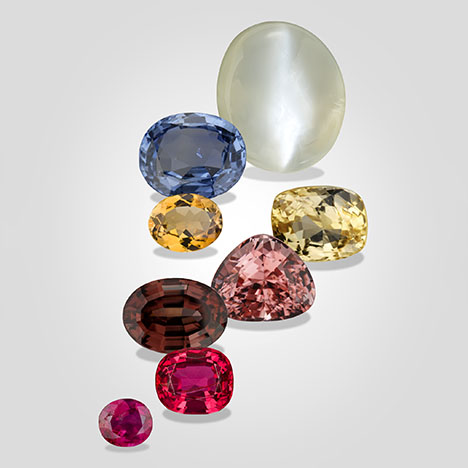
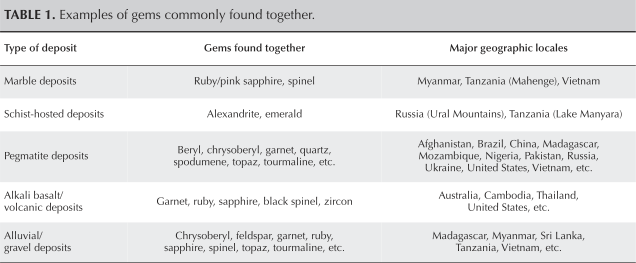
The most significant historic deposit of fine ruby is undeniably the Mogok Valley in Myanmar (formerly Burma). Yet, this deposit is recognized not only for yielding some of the world’s most important ruby, but also for a myriad of other fine gems (figure 1) from blue sapphire to peridot to spinel. Was it a stroke of luck that this relatively small region in Southeast Asia just happens to produce such an amazing diversity of gemstones, or is something more happening beneath the surface? The previous installment of Colored Stones Unearthed covered gems found in pegmatites. These pegmatitic deposits virtually always yield a number of different gemstones in the same deposit, rather than being single gem sources. In contrast, some gem deposits are known for producing almost exclusively one species of gemstone (e.g., the Mozambique ruby deposits, the Zambian emerald deposits, the Australian opal fields). In fact, it is quite common for multiple gems to be found in a single deposit (table 1). This contribution to Colored Stones Unearthed investigates deposits known for producing multiple gemstone species and places these deposits in a broader geological context.
WHY ARE SOME GEMS FOUND TOGETHER
Different gemstones are often found together because they form under similar geological conditions. The specific combination of pressure, temperature, and chemical environment determines which minerals can crystallize in a particular location.
A classic example is Myanmar’s Mogok Valley, where ruby and red spinel are commonly recovered from the same deposits. Although these gemstones are distinct mineral species, their chemical compositions are closely related. Ruby is composed of aluminum oxide, while spinel contains magnesium in addition to aluminum and oxygen. Small variations in the local chemistry can determine whether ruby or spinel forms.
In many cases, multiple gemstone species occur together because the geological environment provides the ingredients necessary for several minerals to develop simultaneously. These relationships help geologists better understand how gemstone deposits form and why certain gem combinations are repeatedly found in the same regions
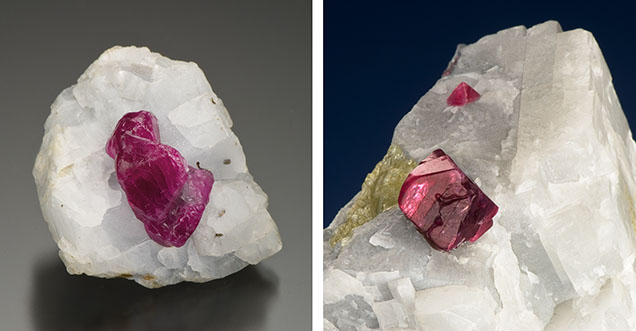
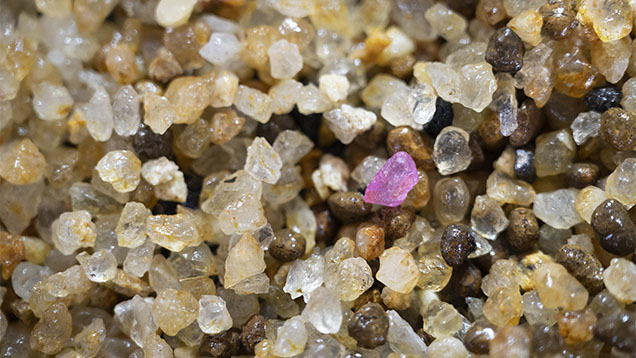
The following section describes several instances in which different gemstones form in a single deposit due to diversity in the chemical environment. The next section covers volcanic deposits, where multiple gems are brought to the surface from great depths by basaltic or other volcanic eruptions. In these cases, the ultimate origin of the different gems found in the same deposit are not clearly understood, but there is almost certainly some genetic link. The final section discusses alluvial or secondary deposits, in which intense, usually tropical, weathering pulls gemstones from multiple geological formations across a broad area, gathering several different gem species together. In many cases, the gems found in these secondary deposits clearly have disparate geological origins involving entirely different formation conditions. The clearest example of this is gem-bearing gravels containing both corundum (ruby or sapphire) and gemmy quartz (figure 3). Under most circumstances, this is impossible as corundum and quartz cannot form in equilibrium at most conditions within the earth’s crust1.
DIFFERENT GEM SPECIES DUE TO CHEMICAL VARIATIONS
Small changes in a deposit’s chemical environment can produce entirely different gemstone species. Geologists use phase diagrams to understand how variations in temperature, pressure, and chemical composition influence which minerals become stable during formation.
The emerald and alexandrite deposits of Russia’s Ural Mountains provide a well-known example. Both gemstones formed under very specific conditions that existed along a narrow chemical boundary. Slight increases or decreases in the availability of silica or aluminum could cause one gemstone to form while preventing the other from developing.
Pegmatite deposits provide another example of chemically diverse environments. These deposits contain unusual concentrations of elements such as lithium, boron, and fluorine, allowing multiple gemstone species—including tourmaline, topaz, spodumene, beryl, and chrysoberyl—to crystallize together within the same geological system.
DIFFERENT GEM SPECIES IN VOLCANIC DEPOSITS
Some gemstone deposits originate from volcanic activity that transports minerals from deep within the Earth to the surface. Basalt-related sapphire deposits are among the most important examples and are found in locations such as Australia, Thailand, Cambodia, Nigeria, and Ethiopia.
These volcanic deposits commonly contain gem-quality zircon alongside sapphire. Although scientists are still investigating the exact relationship between the two minerals, evidence suggests they share a connected geological history linked to alkali-rich magmatic environments. In Cambodia’s Ratanakiri region, blue zircon and sapphire are frequently found together, making the area one of the world’s most notable examples of this type of deposit.
Other volcanic gemstone deposits, such as those in Montana, also produce gem-quality garnets alongside sapphires, demonstrating how volcanic processes can concentrate multiple gemstone species within the same geological setting.
DIFFERENT GEM SPECIES IN SECONDARY DEPOSITS
Secondary deposits form when weathering and erosion break down gem-bearing rocks over millions of years. Because gemstones are generally more durable than the surrounding rock, they survive the process and are transported by water and gravity into rivers, valleys, and gravel deposits.
These deposits often contain gemstones originating from several different geological sources. Ruby, sapphire, spinel, garnet, chrysoberyl, quartz, topaz, tourmaline, and zircon may all become concentrated in the same area despite forming under very different conditions.
Myanmar’s Mogok region provides an excellent example. Ruby and spinel originate from marble formations, while sapphire and other gems come from nearby syenite and charnockite rocks. Over time, erosion carries these gemstones into shared sedimentary deposits, creating exceptionally diverse gem gravels. Similar secondary deposits are found throughout East Africa, Southeast Asia, and Sri Lanka.
1Some exceptional cases of coexisting corundum and quartz assemblages have been documented, although it is unclear if these represent equilibrium or non-equilibrium mineralogical assemblages (Guiraud et al., 1996; Tsunogae and van Reenen, 2006).
It is widely recognized that some gem minerals often occur together in various localities—either in the same host rock or in the same deposit. Gem minerals each require a certain set of physical and chemical conditions for their formation. This edition of the Colored Stones Unearthed column will explore where specific gem minerals are found together and the conditions that produce these distinct geological settings.